Reading Your Child's Birth Chart (What Every Parent Needs to Know)
May 26, 2026Imagine having a guide that helps you see your child more clearly than you ever thought possible—not who you hope they'll become, not who the world expects them to be, but exactly who they already are. Their emotional needs, their learning style, the kind of home environment where they genuinely flourish, and even the deeper soul mission they're here to live out. That guide exists. It's your child's birth chart.
Astrology has always been a powerful tool for self-understanding, but one of the most profound and underexplored applications is using it to support the children in your life. As a parent or caretaker, you are in a uniquely powerful position—because the earlier this kind of understanding is applied, the more it can shape a child's foundation in the most supportive, harmonizing way possible.
This is why I sat down with Amanda McGill, a professional astrologer, graduate of the Cosmic Academy of Astrology, mother of four, and one of our teaching assistants, to talk about what it actually looks like to use astrology as a parenting tool. Amanda doesn't just study this academically—she lives it, with four children whose charts she has watched unfold in real time. What she shared in our conversation is something I think every astrology-curious parent needs to hear.
First, Let's Talk About the Ethics
Before we get into chart placements, we need to set the foundation—because astrology in the hands of a worried parent can go sideways very fast.
The purpose of reading your child's chart is not to bulletproof their life. It's not to fail-safe their future or protect them from every hard thing you can see coming. Amanda puts it plainly: that's not your place, and it's not how this tool is meant to be used. A child's chart is full of potential—potential that hasn't been expressed yet, that hasn't been unlocked. There is far more room to work with than you'll find in an adult chart, where the patterns are already more solidified.
The goal, as Amanda frames it beautifully, is to use astrology as a quiet guide operating in the background. Not a system for micromanaging your child's fate. Not a source of fear, guilt, or shame. A tool that helps you see your child more clearly—not who you want them to be, not who society expects them to be, but exactly who they are—and to gently support them in that.
She quotes physician and child development expert Gabor Maté, who, when asked by a terrified woman if she would inevitably traumatize her children, responded with calm simplicity: Don't worry—you will. Don't let it stop you. The point isn't perfection. The point is awareness, self-compassion, and the willingness to keep learning.
One more important note: you are not going to sit your child down and explain their chart to them. You are not telling a six-year-old they have Saturn in the eleventh house and that's why they struggle to make friends. What you're doing is translating—quietly, internally—and using what you know to show up differently for them. The knowledge lives in you and informs how you parent, what activities you encourage, how you repair after conflict, how you design their environment. That's it.
The Moon: Your Child's Emotional Blueprint
The moon is the first place Amanda looks in a child's chart, and it's the placement that generates the most panic in parents. She gets it—she's been there herself.
The moon represents our emotions, our subconscious patterning, our instincts, our intuition, and our subjective sense of reality. It is largely automatic; you can't reason your way out of your moon. And in astrology, the moon also literally signifies the mother—the original source of nurturing after conception. So when parents see something challenging in their child's moon, the fear that they are the problem is immediate.
Here's how Amanda reframes it, and it's worth sitting with: the moon in a child's chart shows you how to nurture them—specifically, in the way they actually need, not the way you might assume nurturing should look.
Take a Scorpio moon. Most parents hearing that placement immediately brace for something dark or difficult. But a Scorpio moon child needs depth. They need to be truly seen in their most profound, intense emotions—the ones other people might flinch at or step back from. A parent who is willing to go there with them, who doesn't shy away from the psychologically heavy conversations, who offers real emotional holding rather than deflection? That's what nurture looks like for this child. It's not inherently a wound; it can be a gift.
Amanda's youngest son has an Aries moon. Before he could walk, he was climbing. He takes risks, he initiates, he pushes boundaries—and she's learned that for him, emotional nurturance means giving him room to lead. Gritting her teeth a little and letting him go, because that independence isn't recklessness. It's his moon being fed.
A Gemini moon child is going to be deeply curious, social, hungry to explore the world around them. If you're a natural homebody who doesn't particularly love museums or social outings, this is where the chart asks something of you. Not to betray yourself, but to stretch. To recognize that your child's nurturance looks different from your own, and to make the conscious effort to meet them there.
This is the gift of the moon in a child's chart: it shows you that nurturing isn't just words of affirmation and physical warmth, though those matter. Nurturing is specific. It's tailored. And when you understand your child's moon, you stop guessing and start seeing.
For parents who encounter something challenging in the moon placement—and you may—Amanda's guidance is not to catastrophize but to get ahead of it. Look at your own patterns. If you see tendencies in yourself that reflect a lower expression of that moon energy, you can work on them. When you inevitably hit difficult moments in your relationship with your child, knowing their moon helps you know how to repair, and how to do it in a language they can actually receive.
The Fourth House and the IC: The Home They're Experiencing
The next place Amanda looks is the fourth house and the IC—the very bottom of the chart. In whole sign houses, the IC doesn't always fall in the fourth house, which gives you additional layers of nuance to work with. Both points carry similar significations: home, family, ancestry, lineage, the environment a child grows up in, and what they need in order to feel safe and rooted.
This is another area that can feel confronting, because the fourth house and IC can very directly reflect what's actually happening inside your home. Amanda, as a mother of four, has watched this unfold in real time with her own children's charts—what was happening in the family at the time of each birth landing right there in the fourth house, precise and undeniable.
If you see Mars in the fourth house and Saturn on the IC, your first instinct might be dread. But step back. Mars in the fourth could simply reflect parents who are intensely active—athletes, people who move a lot, who bring a high-energy, physical presence into the home. Saturn on the IC, particularly if it falls in the fifth house in whole sign houses, might describe parents who are deeply disciplined but perhaps not as free or playful—a structured environment, not a lot of spontaneous fun.
Now, it can also describe a home with a lot of conflict, a lot of psychological intensity, not enough lightness. But here's the crucial part: if that's your reality, you can look at it directly and decide to change it. If there's too much fighting in front of the children, you take it behind closed doors. If there's not enough joy, you schedule it in—very Saturnian of you, yes, but effective. You go out every weekend. You build fun into the structure because that's what the chart is calling for.
Amanda and I have both seen Saturn IC and Saturn fourth house children grow up in rigid, overly controlled environments and completely rebel. The chart isn't sentencing anyone. It's showing you where the pressure points are so you can work with them before they become breaks. A child who needs structure does need it—but the question is always: how much, and where's the line?
And there's something else worth considering—what Amanda calls remedies. In traditional Hellenistic astrology, remedies have always been part of the practice: using up the energy of a placement so it doesn't express in its harsher form. For a Mars fourth house child, this might look like a home gym, like exercising together, like painting their room a bold, energizing color. For a Saturn IC child, it might look like a minimal, organized bedroom—clean, calm, separate from clutter—a sanctuary that reflects their nature without anyone having to explain why it feels right.
Mercury: Communication, Learning, and Getting on the Same Page
Mercury is often underestimated in family dynamics, but it is one of the most powerful harmonizing placements you can look at—because it governs how we think, how we speak, and how we process information. And in families, miscommunication is at the root of so much friction.
Consider this contrast: a child with Mercury retrograde in Cancer is processing emotionally, deeply, intuitively. They need more time to access their thoughts. They can't be rushed into articulating what they feel or think—the retrograde slows the outward expression even further inward. Now imagine their parent has Mercury in Aquarius, direct, fast, in a square to Mars—immediate access to thoughts, quick, possibly blunt or abrasive. The mismatch is real. Neither is wrong. But without awareness, that parent is going to unintentionally bulldoze a child who needs silence to find the right words.
Knowing this doesn't change who you are. Your Mercury placement isn't going anywhere. But it can change how you show up, especially in moments of repair. You can consciously soften. You can give more time. You can meet them where they are rather than where it's easy for you.
Mercury also speaks directly to how children learn, and this is enormous for parents making educational decisions. Astrology is not a diagnostic tool—Amanda is clear on this—but Mercury can offer real insight into learning style, processing speed, attention, and the kind of environment in which a child is most likely to thrive.
A Mercury in Capricorn child might be more studious and methodical, needing structure to feel grounded in their learning—whether that's in a traditional school or a home education setting. A Mercury in Pisces conjunct Neptune in the fourth house is going to be highly creative, deeply imaginative, likely in need of privacy and decompression time at home. A busy, loud school environment may genuinely be hard for them—not because anything is wrong with them, but because their mind lives partly in the invisible world, and that's not a character flaw, it's a feature. If a smaller school or a Waldorf-style environment isn't accessible to you, you work with what you have: you ensure they have that sanctuary at home, a private space to decompress, activities on the weekends that are creative and quieting rather than overstimulating.
There is always a remedy. That's the thread running through all of this.
The North and South Nodes: Their Soul's Direction
The nodes are the place where Amanda urges the most caution—because this territory touches destiny, and it's easy for a well-meaning parent to tip from supporting into controlling.
The south node represents mastery. It's what the soul knows, what it's comfortable with, what it will default to. The north node is the opposite: it's unfamiliar, uncomfortable, the direction the soul is being called toward in this lifetime. We don't move toward our north node because it's easy. We move toward it because something in us is being pulled there despite the discomfort.
In children, the south node is often strikingly visible. It's present and prominent. And while it might look like a strength—because it is, in many ways—it can also become a holding pattern. The soul is not here to stay in its comfort zone.
A child with a Libra south node is naturally harmonizing, peaceful, probably easy to be around, likely artistic and socially gracious. But they may struggle enormously with self-assertion, with identifying their own needs, with separating their sense of self from others. They might find themselves in friendships that don't serve them, because keeping the peace feels safer than speaking up. Their north node is Aries—courage, independence, self-initiation.
You cannot hand them their north node. You can't tell a child this is their purpose and expect that to do anything useful. What you can do is gently, quietly tilt the scales. You tell them: you can do this. You encourage them toward risk, toward activities that build independence, toward experiences that require them to assert themselves. You choose the bedtime stories that celebrate courageous protagonists. You suggest the sport or the class that might be a little outside their comfort zone.
You're not forcing. You're not micromanaging. You're creating the conditions in which their soul's work becomes slightly more possible. That is enough. The north node will always involve challenge—you cannot remove that from their experience, nor should you try. But you can make the territory a little more familiar.
A Final Word on All of This
These four pillars—the moon, the fourth house and IC, Mercury, and the nodes—are not the entirety of what a child's chart holds. There is always more. But they are powerful starting places, the places where the most meaningful support for a child's development and the most meaningful insight for a parent tends to live.
The whole point of this is not to create more fear. It's to create less. Astrology, used this way, is not a system for predicting your worst moments as a parent. It's a way of stepping back from the anxiety of trying to do everything right and instead learning to see your child more clearly—more specifically, more compassionately—and to work with their nature rather than against it or alongside it in ignorance.
There is immense healing in that. And there is immense beauty in the fact that astrology gives us a language for it.
Want to Go Deeper?
If you're a parent who's been piecing things together from YouTube videos and feeling more confused than clear, this is exactly where you need to be.
And if you're looking for a reading specifically tailored to your relationship with your child—one that looks at the dynamics between you, the karma, the nurturing needs, the communication styles, the learning blueprint—Amanda offers a mother-child reading through her practice, Birth of You. You can find her at thebirthofyou.com.
Are you a new astrologer working to deepen your connection to your birth chart?!
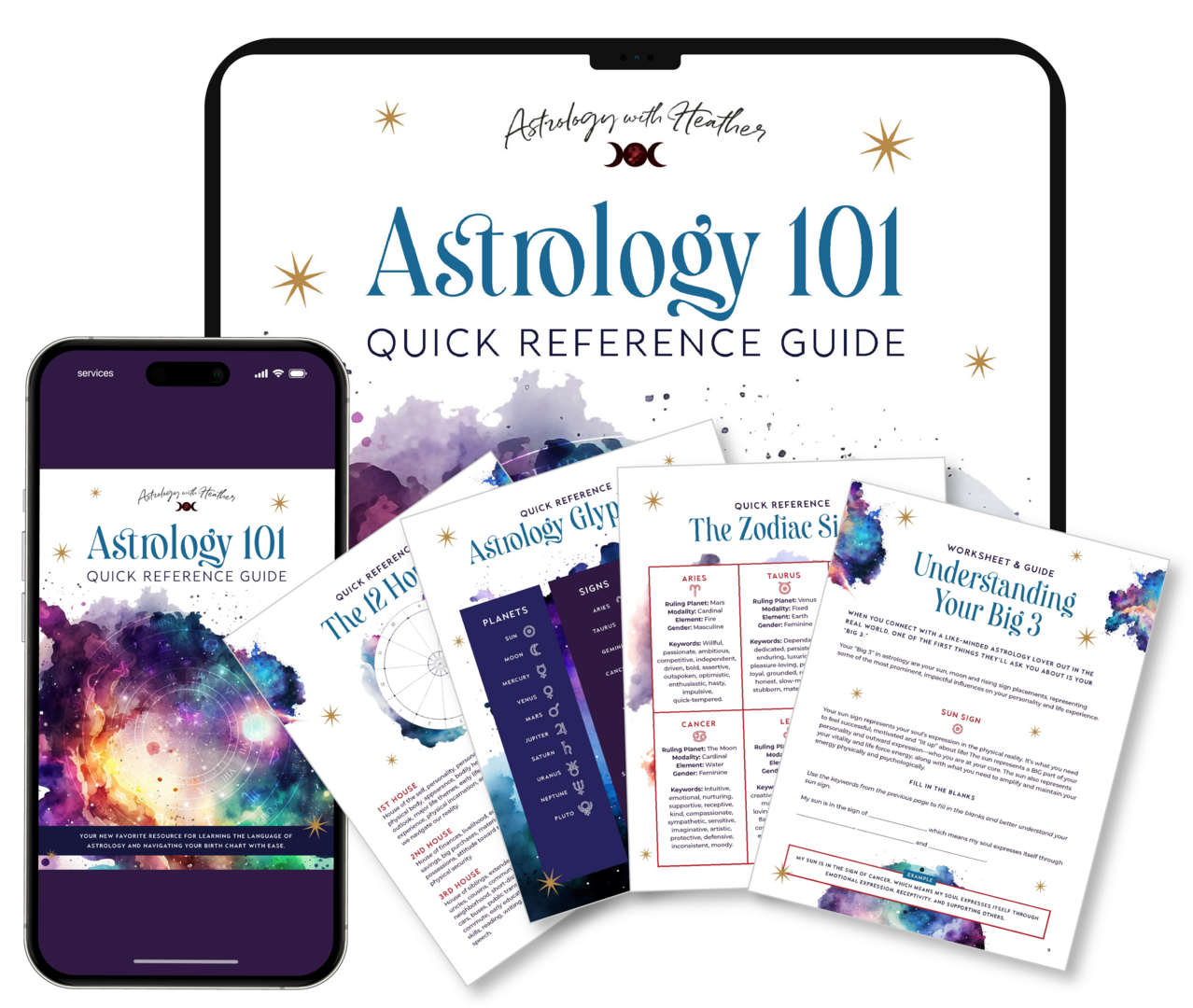
Fill out the form below and I’ll email you my Astrology 101 Quick Reference Guide, which has EVERYTHING you need to dive deeper💫